CO₂ is not a waste gas.
It is the fuel.
Eighty per cent of the world still treats carbon dioxide as something to flush out. It is the fuel for self-regulation, the threshold that activates HRV, the brain maps and the neurochemistry of coherence. We don't ask you to believe it. We ask you to measure it.
Regulating the nervous system to sustain mind-heart coherence
Alchemy combines ancient practice with modern science: breath holds that build CO₂ tolerance and take you over a threshold you cannot reach by willpower. Diagnoses of neurodivergence, ADHD, autism, anxiety, keep rising, and the method was built to help those systems find their center.
Mind-heart coherence is the state where brain, heart and body move in harmony. Heart rate variability, the small beat-to-beat changes in your heart rhythm, is a window into the quality of communication between heart and brain, and it directly shapes how you think, feel and perform.

Three mechanisms that explain the rest
The CO₂ Threshold
Your brain reads rising CO₂ as an emergency signal. When tolerance is low, ordinary stress trips a full fight-or-flight response. Raise the threshold and you become harder to activate, this is the engine, not a side effect.
The Baroreflex
Cadence breathing at 5.5 breaths/min synchronises your heartbeat with your breath, activating the baroreflex, your body's natural blood pressure and stress regulator. This is the mechanism behind HRV coherence.
Polyvagal Regulation
The vagus nerve is the highway of the parasympathetic nervous system. Slow exhale-extended breathing directly stimulates vagal tone, shifting your nervous system from threat to safety mode.
Breath + mind navigation
The method draws a clear line through the history of breath. Holotropic and hyperventilation work (Stanislav Grof, 1960s) moves through over-breathing. Pranayama refined breath mastery in the Sanskrit tradition more than two thousand years ago. The Buteyko method (Dr. Konstantin Buteyko, 1952) worked in the opposite direction, toward CO₂ tolerance and reduced breathing.
Alchemy builds on that last branch and combines it with CO₂ elevation borrowed from freediving, uncovering the link between breath, CO₂ and neurodivergence, and a practice that supports both neurotypical and neurodivergent people toward greater calm, clarity and inner freedom.
Breath-mind navigation is the practice of working intentionally with breath holds to build CO₂ and enter altered states, where peak emotions and sensations are met, navigated and moved through, on the way to clearer awareness of self.
The five pillars, and the science of each
CO₂ Tolerance & Navigation
Hypoxia, and building new pathways
Building CO₂ tolerance creates a short, controlled form of hypoxia, a mild stress at the cellular level. As with training a muscle, the body adapts and strengthens: circulation, lung capacity and metabolic efficiency all respond. The peak of discomfort during a breath hold is a momentary stressor you learn to move through, and moving through it, with the neurochemistry that follows, is how new neurological pathways are laid down over time. By meeting the edge of CO₂ on purpose, you train yourself to live from your center.
Physical Stress & Exercise
Hormetic load, and staying calm inside it
The adaptation that builds CO₂ tolerance is the same one that answers physical stress, so the two train together. In the static bicycle practice you pedal continuously through fifteen two-minute cycles, holding the breath for a widening portion of each one: twenty seconds in the first week, forty by the third. The demand rises while you deliberately keep the body soft. That combination, real physical load met with a relaxed system, is what carries the tolerance out of the session. The nervous system learns that effort and alarm are separable, and stops reading the one as the other.
Keto-Adaptive Diet
Clean fuel, on a circadian clock
Coherence is expensive, and the body cannot hold it on unstable fuel. Ketosis, alkalinity, fermented food and cycled nootropics give the brain a steady supply rather than the peaks and crashes of glucose, and the timing matters as much as the content: mornings for fats, collagen and the vitamins that activate the liver; evenings for the minerals and electrolytes that repair the system and carry it into deep, restorative sleep. The day becomes a sequence, activation, performance, decompression and recovery, in step with the sun. This is less a diet than a neurological architecture, and it is the reason the state becomes something you live in rather than something you visit.
Live Music Resonance
Frequencies the nervous system rides
The right sound, applied well, has a real effect on the nervous system, the vagus nerve and the state of the brain. In every live Alchemy experience the musicians do not plan their score. They co-create in response to the group and the room, an improvised, intuitive guide that lets you work with the breath more freely and move between brain-wave states, rather than a fixed performance played at you.
Structured Reintegration
Restoring the vagus nerve
Breath has a major influence on the vagus nerve, the longest nerve in the body and a key part of the autonomic nervous system, governing both the fight-or-flight response and how quickly you return to rest-and-digest. Vocal activation, humming and singing, raises vagal tone and signals safety through the body. Somatic movement, shaking, dancing and embodied release, helps process what is held in the body, so coherence lasts instead of fading.
The mechanism, in a room
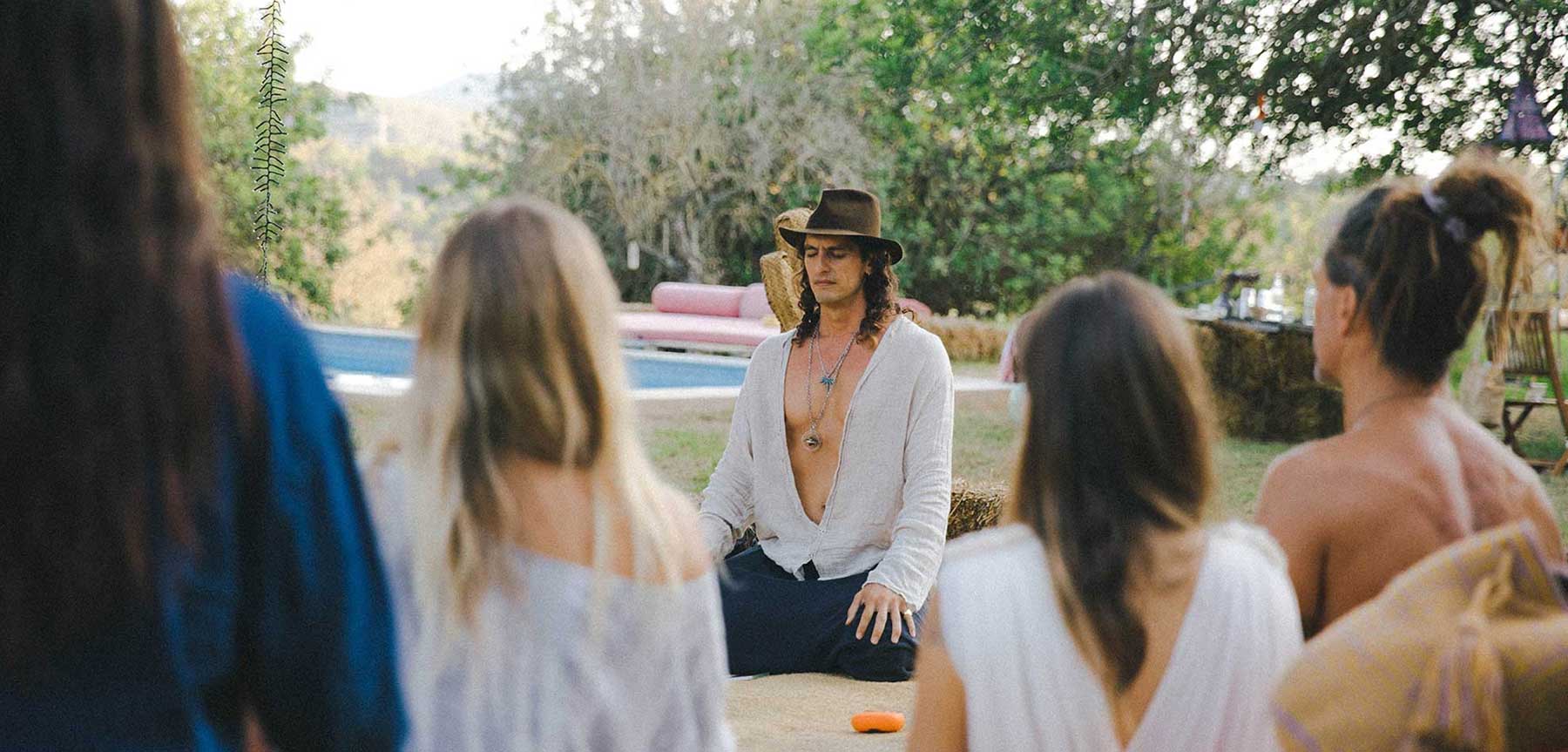
These mechanisms aren't abstract. Watch how cadence breathing, CO₂ holds and live sound move a group from threat into regulation, the baroreflex and vagal tone at work, in real time.
What the practice supports

Measured, not promised
The nervous system learns intensity isn't danger.
A pilot study with MuLabs, Lisbon
In late 2023, the founder and 19 experienced practitioners, aged 29 to 46, took part in a pilot run by MuLabs in Lisbon, measured with EEG and biomarkers (heart rate, HRV, respiratory rate, cardiogram). We frame it as exactly what it is: a small pilot. Early, real, and ours, not a large clinical trial. These are its directional findings.
Peripheral nervous system
Lower heart rate and higher HRV, markers of a body moving into a relaxed, down-regulated state.
Central nervous system
More theta and delta activity in frontal regions (deeper relaxation) and more gamma in posterior regions (greater coherence), pointing to improved neural communication.
Hormonal
A reduction in cortisol, the primary stress hormone, consistent with a shift toward a calmer, less stressed state.
CO₂ tolerance & the stress threshold
The chemoreceptors that sense rising CO₂ help set how readily the body trips into fight-or-flight. Raising tolerance raises the threshold.
Cadence breathing & HRV coherence
Slow breathing with a longer exhale synchronises heart and breath and engages the baroreflex, the basis of heart-rate-variability coherence.
Vagal tone & the parasympathetic shift
Exhale-extended breathing stimulates the vagus nerve, moving the nervous system from threat toward safety.
EEG & the measured state
Structured breath practice can produce measurable shifts in brain activity, the layer MuLabs measures with us, directly.
Where the accountability lives
The work with MuLabs is ongoing, part of a longer partnership measuring what elevated CO₂ and structured breath actually do in the nervous system. The founder's own scans have shown positive stimulation of the pre-frontal region, associated with empathy, presence and self-connection. We keep measuring rather than overclaiming.
A note on numbers: a metric you understand is a tool; a metric you don't can become a source of anxiety. We give you your data as meaning, never as a scoreboard.
The two sides of neuroplasticity
The bright side
Neuroplasticity is what makes the brain resilient, able to recover from injury and to learn new ways of responding. It is how people move out of depression, addiction, obsessive patterns and the harder edges of ADHD, by repeating a better response until it becomes the default.
The dark side
The brain is always learning, and it is neutral, it doesn't judge good from bad. It learns whatever you repeat. Left unattended, that entrenches the anxious, reactive and depressive patterns just as easily. Which is why the practice is deliberate: you choose what gets rehearsed.
Measure your own results
The method is built so you can see your own patterns, your Control Pause, your HRV, your coherence, read as meaning, never as a scoreboard.